
1. Alarm monitoring system
The Alarm Monitoring System (AMS) is a key component of a ship’s automation and safety network, designed to monitor, display, and record alarms from various equipment and systems on board. Installed in the Engine Control Room (ECR) and sometimes extended to the Bridge, this system continuously supervises machinery operations, detecting any abnormal conditions in engines, pumps, generators, and other vital systems.

When a fault or abnormal parameter is detected, the AMS automatically activates visual and audible alarms. Allowing engineers to take immediate corrective action. The system provides detailed alarm logs, sensor readings, and event histories, which are essential for troubleshooting and preventive maintenance. Through real-time monitoring, it helps maintain operational safety, machinery reliability, and system efficiency across the entire vessel.

2. Provision crane
The Provision Crane is an important electro-hydraulic lifting system installed on most modern vessels to handle and transfer ship provisions, spare parts, and light cargo during port operations. Usually located on the main deck near the accommodation area, this crane is designed for safe, efficient, and flexible loading and unloading of materials from the quay or supply boat directly onto the ship.
Operated by a joystick control or remote system, the Provision Crane uses hydraulic cylinders and electric motors to lift and swing loads with high precision. It is equipped with limit switches, overload protection, and emergency stop features to ensure safe operation under various sea conditions. The system’s automatic safety features make it a reliable part of the ship’s deck machinery and handling automation network.

3. Screw compressor
Screw compressors are air compressors used to generate air pressure for valve systems or cylinder units on ships. This pressure ensures stable operation of mechanical components.
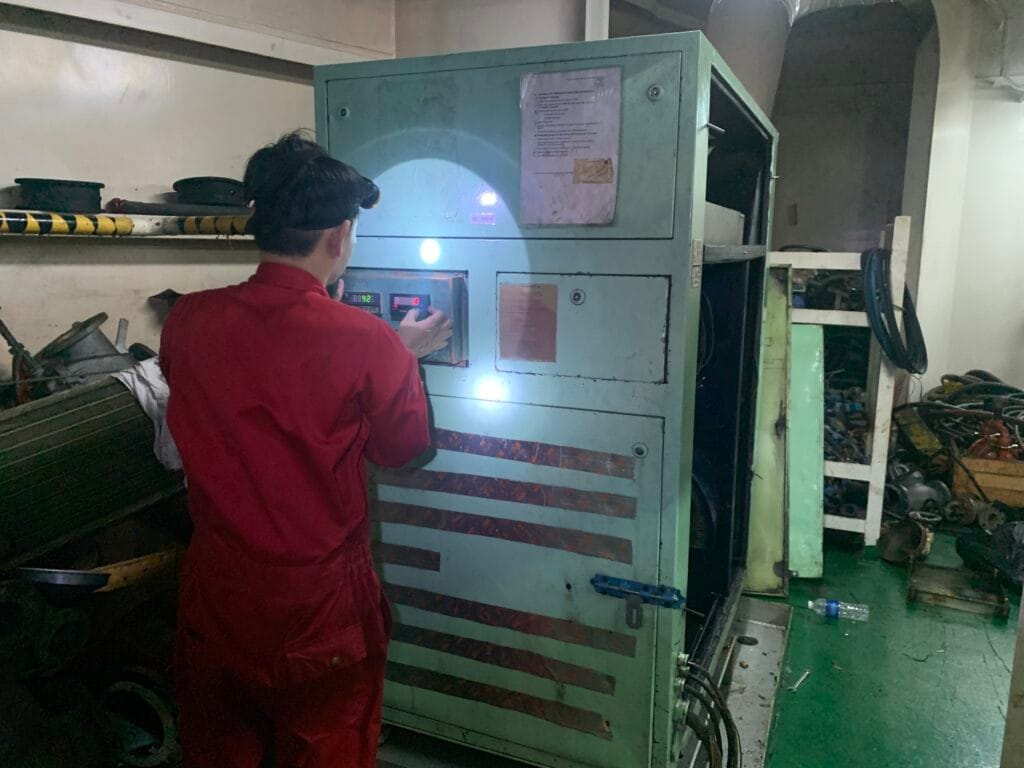
The HATLAPA air compressor system works on the same principle — providing compressed air to start and operate mechanical systems. It uses screw-type compression, where lubricating oil is injected into the screw chamber to seal and cool the unit. The air-oil mixture then passes through a filter, separating clean air into the tank while oil is returned to the system. This design allows continuous operation, high air capacity, and reduced vibration.
In one example, a HATLAPA system modification was carried out on an oil tanker. The system had a control failure in the pressure and temperature display. Our team repaired the display section and redesigned the electrical starting system for stable performance and reliability. This ensures the compressor operates efficiently in all marine conditions.

4. Boiler control system
The Boiler Control System is a key part of a vessel’s automation and engineering network, designed to automatically monitor, control, and maintain steam generation for various shipboard operations. Installed in the Engine Control Room (ECR) and connected to the main boiler unit, this system ensures the safe and efficient production of steam used for heating, fuel treatment, cargo operations, and other auxiliary systems.
The system continuously regulates water level, steam pressure, temperature, and fuel supply through automatic sensors and control valves. In case of abnormal conditions such as low water level or high pressure, the Boiler Control System triggers visual and audible alarms and can automatically shut down the burner to prevent damage or explosion. This automation greatly reduces the need for manual monitoring and enhances operational safety and energy efficiency.

5. Engine Remote Control System (ERCS)
The Engine Remote Control System (ERCS) is one of the most essential automation systems installed on modern vessels, designed to control and monitor the main engine directly from the Bridge or Engine Control Room (ECR). This system allows the ship’s officers to start, stop, and adjust engine speed and direction remotely, ensuring smooth and efficient propulsion control during navigation and maneuvering.
The ERCS integrates with other key systems such as the Alarm Monitoring System, Autopilot, and Power Management System, forming the core of the vessel’s engine automation network. It uses a combination of electronic controllers, feedback sensors, and pneumatic or hydraulic actuators to transmit control signals between the bridge and the main engine. In case of failure, the system automatically switches to local engine control mode, ensuring continuous operation and safety.